
What another season of "we'll deal with it later" actually costs
Here's the argument-settler: an old garage door isn't dangerous because it's old. It's dangerous because of two or three specific things that either work or don't. Ignore those for one more winter and you're not risking a cosmetic eyesore, you're risking a 150-pound door that doesn't stop when it hits something, or springs that let go while someone's standing under them. That's not a maybe. That's how people get hurt or end up with a smashed car bumper and a door that won't move until spring.
The good news for whichever one of you wants to keep the door: most of what makes an old garage door feel "old" is just wear, not risk. You can leave a lot of it alone. But a short list of things genuinely needs attention before the ice and salt season gets going, because cold snaps are exactly when worn safety components fail.
The part that's actually dangerous: no auto-reverse
If your garage door opener was installed before 1993, it almost certainly doesn't have photo-eye sensors — the two small sensors mounted a few inches off the floor on either side of the track that stop the door if something breaks the beam. Without them, a closing door has no way to know a kid, a pet, or a bike is underneath it. It just keeps coming down.
This is the one item that isn't up for debate. Test it: close the door and wave a broom handle through the opening partway down. If the door doesn't reverse, you don't have working auto-reverse, whether that's because the sensors are missing, misaligned, or the opener predates them entirely. Retrofitting modern photo-eye sensors onto an older opener is a straightforward, low-cost fix in most cases. If the opener itself is too old to accept them, that's a sign the whole opener needs replacing, not just the sensors.
The other non-negotiable: extension springs without safety cables
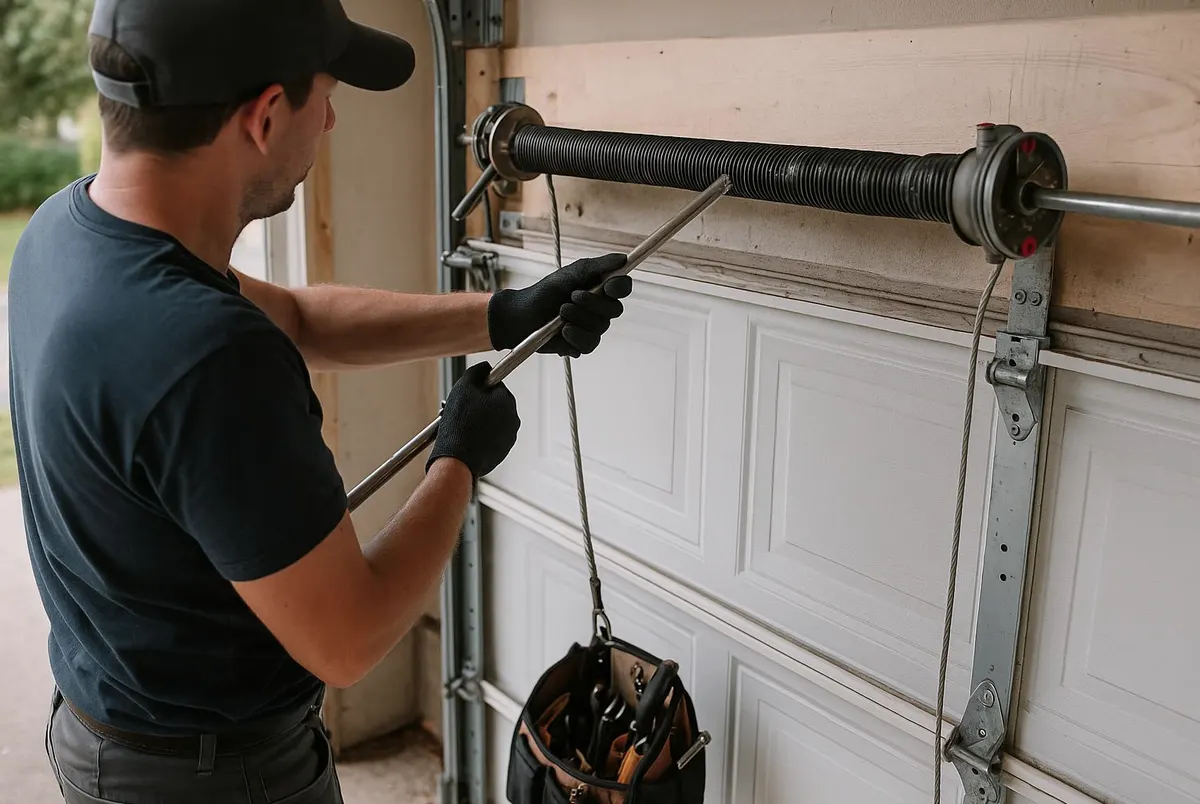
Look up at the springs above your door tracks. If you see long, stretched coil springs running parallel to the horizontal track (rather than a thick torsion spring mounted on a bar above the door), those are extension springs. Older installations often skipped a critical safety feature: a cable threaded through the spring's center that keeps it contained if it snaps. Without that cable, a failed spring becomes a projectile — straight through drywall, windows, or whoever's standing nearby.
Our seasonal swings make this worse than it sounds. Springs flex thousands of times a year, and the stress of going from a humid August to a hard freeze accelerates metal fatigue. An old spring that's made it this long isn't proof it's fine — it's often closer to the end of its rated cycle count than you'd guess. Adding safety cables is cheap insurance. If the springs look rusted, stretched unevenly, or have visible gaps between coils, replacement is the honest answer, not a patch.
What's just old, not dangerous — leave it alone
This is where a lot of arguments start, because "old" gets used to mean "broken," and it isn't always true.
- Solid wood or heavy steel panels that aren't rusted, delaminating, or sagging are fine to keep. A well-built door from the 90s can easily outlast a cheap new one.
- Manual locks and slide bolts on doors that don't have an opener still work exactly as designed. There's no safety upgrade needed for a door you lift by hand.
- Original hinges and track brackets, if they're not cracked, bent, or missing bolts, don't need replacing just because they look dated. Function matters more than age here.
- Cosmetic wear — faded paint, dated window inserts, a slightly mismatched color — is a style decision, not a safety one.
If the spouse pushing to "just replace the whole thing" is doing it for looks, that's a fair conversation to have on its own terms — but it's not a safety argument.
The middle-ground stuff: watch it, don't panic about it
Some parts wear out gradually and are worth checking each fall rather than replacing on a whim: rollers (plastic ones get brittle and crack in cold weather, nylon holds up better), hinges that squeal or show metal shavings underneath, and weatherstripping along the bottom that's cracked or torn. None of these will hurt anyone if they fail, but they will make the door louder, harder to operate, and let in drafts and road salt spray right when you don't want either.
When to call us, and what we'd actually do
If the broom-handle test fails, if you've got uncabled extension springs, or if you're just not sure what you're looking at above your garage door, that's exactly the kind of thing New Holland Garage Door checks during a garage door maintenance visit. We inspect the opener's safety reversal, check spring type and condition, and tell you straight whether something needs a retrofit, a repair, or nothing at all. If the springs do need attention, our spring replacement work includes proper safety cables and the correct spring size for your door's weight, so you're not guessing.
If you're in New Holland, Circleville, Washington Court House, or anywhere nearby and you've got a garage door that predates a lot of today's safety standards, give us a call before the hard freezes set in. We'll tell you what's actually worth fixing and let you settle the argument with facts instead of guesses.