
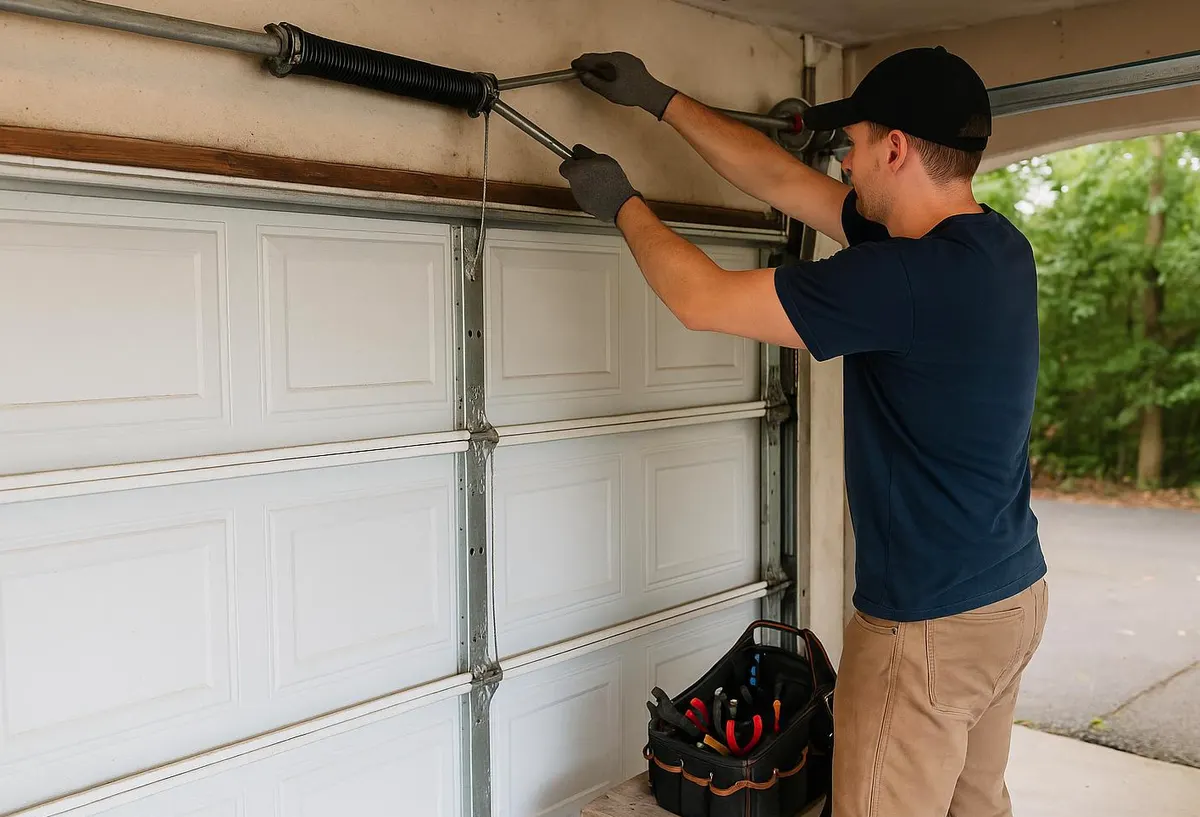
What a Technician Sees on a Typical Opener Call
Most opener calls in this area start the same way: a homeowner says the door is "acting up" — it reverses for no reason, the remote works sometimes but not always, or the unit makes a grinding noise before the door even moves. When a technician opens the housing, it's usually one of a handful of things: a stripped plastic gear, a worn drive belt or chain, a failing circuit board, misaligned safety sensors, or a dead capacitor on the motor. Age matters a lot here. An opener that's five years old with one bad part is a different conversation than a twelve-year-old unit that's had three service calls already.
Big seasonal swings play a real role. Cold snaps make plastic gears brittle and can cause chains to bind as metal contracts. Humid summers are hard on circuit boards and can corrode contacts over time. Spring storms bring power surges that fry logic boards outright. None of this means every opener needs replacing — but it does mean the repair-versus-replace decision should factor in how much wear the unit has already absorbed, not just what's broken today.
Side-by-Side: Repair vs. Replace
Repairing the Existing Opener
- Typical cost: Single-component repairs (circuit board, sensor realignment, gear kit, capacitor) generally fall in the $150–$350 range nationally, depending on the part and labor.
- Best candidates: Openers under 8 years old, one isolated failure, motor and drive mechanism otherwise sound.
- Upside: Lower upfront cost, keeps a unit you already know works with your door's weight and spring setup, less disruption.
- Downside: If the opener is older, you may be paying to fix one problem while a second one is already forming. Repeated service calls over a few years can quietly add up to more than a new unit would have cost.
Replacing the Opener
- Typical cost: A new opener installed, including labor, generally falls in the $350–$600 range nationally, with higher-end belt-drive or smart models costing more.
- Best candidates: Openers 10+ years old, multiple failures in a short period, chain-drive units without rolling code security or modern safety reversal sensors, or homes where the opener runs a heavier insulated door that's working the motor harder than it was designed for.
- Upside: One cost instead of several scattered ones, better reliability through temperature swings, modern safety sensors that meet current standards, and often a battery backup option — useful here when storms knock out power.
- Downside: Higher cost upfront, and it's a sunk cost if the old unit genuinely only needed one small fix.
Running the Five-Year Math
Here's where the decision usually gets clearer. A single $200 repair on a younger opener is an easy call — fix it and move on. But if a technician sees an opener that's already had one or two prior repairs and is now showing a third issue, the math shifts. Two repairs at $200–$300 each, spread over two or three years, often lands close to or above the cost of a new opener installed once. And that new opener typically comes with a warranty that covers the next several years outright, while a repaired older unit carries no such guarantee on the parts that haven't failed yet.
Housing stock matters too. A lot of homes in this area have older attached garages with openers installed well over a decade ago, often chain-drive models that have been reliable but are now past the point where parts replacement makes sense. For these, replacement tends to be the better five-year decision — not because the old unit is "bad," but because it's at the stage where failures start compounding.
A Practical Recommendation for Typical Homes Here
For most homes in and around New Holland, the rule of thumb a technician would use is this: if the opener is under 8 years old and the problem is a single clear fault, repair it. If it's 10 years or older, has already needed a repair in the past two to three years, or lacks rolling code security and modern safety sensors, replacement is usually the better value once you look past the sticker price and factor in avoided service calls, better cold-weather reliability, and the option of battery backup for storm season.
When to Call New Holland Garage Door
If your opener is acting inconsistently, grinding, or failing to reverse properly, that's worth a visit before it fails completely — often during a cold morning or a storm when you need the door most. New Holland Garage Door handles both Garage Door Opener Repair & Installation and ongoing Garage Door Maintenance, so a technician can diagnose whether you're looking at a quick fix or a unit that's reached the end of its useful life, and walk you through the real cost trade-offs for your specific door and garage.
If your opener in New Holland, OH is giving you trouble, call New Holland Garage Door for an honest assessment and a straightforward recommendation — no guesswork, no upsell.